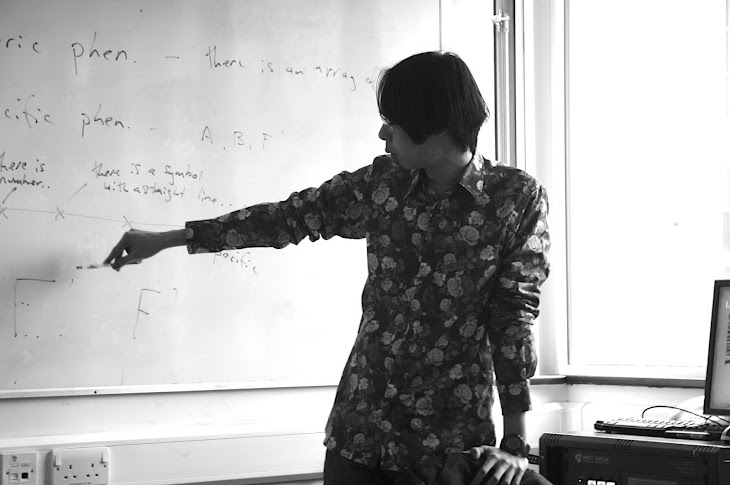
Many things have happened during this period, mostly good things. The visiting to U.C. Berkeley was great - as before I am always very productive there. I have restarted to submit papers for publication, and there have been some success. A paper on the Molyneux's question is out on i-Perception, and another one on Kripkenstein is out on Philosophical Investigations. Both were written at Berkeley, though in different years. There are more to come.
At Berkeley, I visited several labs, including visual space lab led by Marty Banks and Alison Gopnik's developmental lab. In 2015, the visit to UCL's Institute of Cognitive Neuroscience with Patrick Haggard has been very fruitful: the first half of it I was part of the team exploring thermal grill illusion without touch, and the second half we wrote a paper together for The Body and the Self, Revisited. The part-time psychology course at Birkbeck is almost done. The engagement of science has been the main theme of 2015 for me.
The main thing I will need to focus on from now on is the dissertation. The main themes have been objectivity, space and perception, but the exact shape is unstable. I am not sure how much I will need to worry about this. Every year I meet with my supervisor ten times or more, and we have good discussions. But most materials written for supervisions cannot be used in the draft. I don't know what to do. But I guess there is no way out of this. I simply need to carry on (and hopefully keep calm).
2015年12月30日 星期三

2014年8月23日 星期六
Progresses at UCL
Since the last note, lots of things have happened and I am never in the mood to update. Even now I feel a bit lazy, but just for my own record, here are several lines.
The part-time course at Birkbeck is going fine: I will do research methods I and II, and developmental psychology, and that would fulfill the basic requirement. Other than that, I seek to gain practical experiences by participating experimental works. Earlier this year I joined the "Rethinking the Senses" project" run by the CenSes under University of London, and will be part of it throughout. From January 2015 I will join the Action and Body lab run by Patrick Haggard at Institute of Cognitive Neuroscience for a year. At the same time I attend lab meetings of Matt Longo's BodyLab on regular basis. All these are very exciting, but I do not pretend that I am doing well now, and I am not even sure how far I can go down this route. Whenever I hear academic conversations from people in sciences I still feel quite lost. But in any case this is what I feel like doing now so will carry on and see how it goes.
As for philosophy, I just finished the MPhil. Stud. with a thesis on visual attention and discrimination. It's continuous with my thesis at CUNY, but now I approach it with a different angle, namely perception of magnitude and related notions. This is something that I will keep working on in the future, but after submitting the thesis I will take a break from it and move on to other areas within philosophy of perception.
At this point I am sitting on a desk I used to work at U. C. Berkeley. Next time when I update it will be my adventure here.
The part-time course at Birkbeck is going fine: I will do research methods I and II, and developmental psychology, and that would fulfill the basic requirement. Other than that, I seek to gain practical experiences by participating experimental works. Earlier this year I joined the "Rethinking the Senses" project" run by the CenSes under University of London, and will be part of it throughout. From January 2015 I will join the Action and Body lab run by Patrick Haggard at Institute of Cognitive Neuroscience for a year. At the same time I attend lab meetings of Matt Longo's BodyLab on regular basis. All these are very exciting, but I do not pretend that I am doing well now, and I am not even sure how far I can go down this route. Whenever I hear academic conversations from people in sciences I still feel quite lost. But in any case this is what I feel like doing now so will carry on and see how it goes.
As for philosophy, I just finished the MPhil. Stud. with a thesis on visual attention and discrimination. It's continuous with my thesis at CUNY, but now I approach it with a different angle, namely perception of magnitude and related notions. This is something that I will keep working on in the future, but after submitting the thesis I will take a break from it and move on to other areas within philosophy of perception.
At this point I am sitting on a desk I used to work at U. C. Berkeley. Next time when I update it will be my adventure here.
2013年9月22日 星期日
A part-time psychologist
I don't really know how to start describing all these.
Since ASSC in 2008, I have been very impressed by empirically-informed philosophy.
However, given many reasons and excuses, many of them cultural, I stayed in my comfort zone. I did very traditional philosophy of mind and epistemology. There is nothing wrong with them. I had fun, and I still like them. Still, I feel that something is missing; something I do not know how to even begin to learn.
When I moved to CUNY in 2010, I have been entirely converted. One single most important thing the western world taught me is that it is never too late - people around me are keen to learn new things, including those are already in their seventies. Why can't I learn new knowledge in unfamiliar areas, even if I was already 30 or so?
The question is how. I had been surveying many ways to learn psychology and neuroscience. I audited classes, studied text books, read papers, attended talks, spent time with scientists. I did learn much from all these, but nothing systematic; nothing good enough to help my research. I felt that I have been doing this for several years but it did not work
During a trip to Berkeley in 2011, I had much time to rethink my approach. At that time I was pretty sure that I will move to London after 2012, so I checked resources in London. I discovered that at Birkbeck there are flexible courses for those who do not have background. Other schools have similar resources too, though many of them are MSc that might be too challenging for me. Basically, I will not get in most of them. But since then I have borne this information in mind.
And I moved to London. Now it has been one year. Lots of things happened during this year, and I have been considering how to start this adventure. Last week, I finally figured out what I should do and all the details. I am starting a certificate course at Birkbeck from this term. It consists of 6 courses that roughly cover the first 1.5 years in undergrad. This is exactly what I need. At the same time, I will seek to apply for MSc for next year's entry. It might not work, but in that case I will simply complete the certificate course. It sounds humble or even boring, but nothing better I can do. I will start from scratch.
The story has been cut down very short, but it should be enough for those who care about my progress. So far I have only got the student ID and nothing has started. But from next week the new adventure will begin. No matter whether this is silly, I am definitely doing it.
Since ASSC in 2008, I have been very impressed by empirically-informed philosophy.
However, given many reasons and excuses, many of them cultural, I stayed in my comfort zone. I did very traditional philosophy of mind and epistemology. There is nothing wrong with them. I had fun, and I still like them. Still, I feel that something is missing; something I do not know how to even begin to learn.
When I moved to CUNY in 2010, I have been entirely converted. One single most important thing the western world taught me is that it is never too late - people around me are keen to learn new things, including those are already in their seventies. Why can't I learn new knowledge in unfamiliar areas, even if I was already 30 or so?
The question is how. I had been surveying many ways to learn psychology and neuroscience. I audited classes, studied text books, read papers, attended talks, spent time with scientists. I did learn much from all these, but nothing systematic; nothing good enough to help my research. I felt that I have been doing this for several years but it did not work
During a trip to Berkeley in 2011, I had much time to rethink my approach. At that time I was pretty sure that I will move to London after 2012, so I checked resources in London. I discovered that at Birkbeck there are flexible courses for those who do not have background. Other schools have similar resources too, though many of them are MSc that might be too challenging for me. Basically, I will not get in most of them. But since then I have borne this information in mind.
And I moved to London. Now it has been one year. Lots of things happened during this year, and I have been considering how to start this adventure. Last week, I finally figured out what I should do and all the details. I am starting a certificate course at Birkbeck from this term. It consists of 6 courses that roughly cover the first 1.5 years in undergrad. This is exactly what I need. At the same time, I will seek to apply for MSc for next year's entry. It might not work, but in that case I will simply complete the certificate course. It sounds humble or even boring, but nothing better I can do. I will start from scratch.
The story has been cut down very short, but it should be enough for those who care about my progress. So far I have only got the student ID and nothing has started. But from next week the new adventure will begin. No matter whether this is silly, I am definitely doing it.
So Long, Fred
To my
memory I met Fred Dretske twice. The first time was at Rutgers Epistemology
Conference 2011. During one long coffee break (30 mins or so), he was left
alone in the middle of the crowds by random. I was not going to talk to him,
since although my thesis back then was related to his hyper OVERFLOW view about
the content of consciousness (i.e., an extreme version of Ned Block's relevant
view), at that moment I was not ready to ask questions about it. But in any
case he had been left alone for a while (which is not normal given who he is),
so I made a move and brought up the issues I'd like to talk about. He was keen
to discuss it and found a table for us, which was unexpected - I thought he
might have simply said something quickly and tried to leave. As a result we
discussed relevant issues for at least 20 minutes. The overall message is that
he was provoked by Daniel Dennett's extreme sparse view and attempted to count
against it, and my position was that Fred's view is an overreaction and is not
well supported by his arguments. I still hold this verdict today.
The
second time we came across was at Pacific APA 2012, where he presented his
critic of Susanna Siegel's book on the content of visual experience. My view
was different from both, but I learned something important from Fred's
comments. I was surprised by the fact that he not only showed up at conferences
given his age, but also presented something for us. During that conference I
did not have a chance to further talk to him, but both of us attended a session
where Josh Weisberg and Adrienne Prettyman were presenters and Richard Brown
was a commentator. Fred asked helpful questions during the session. He saw me
in the audience and waved to me. I believe he might not recall my name but it
does not matter. That was a nice farewell.
Given
that Fred was still active last year, I presume his last days were not too
painful. I might be wrong, but that is my wishful thinking.
Like
many philosophers in my generation, I have not had a chance to study his
classic works carefully. But I will. My thesis at CUNY has the title
"Consciousness and the Flow of Attention," which was unabashedly
inspired by Fred's seminal work. I am glad that as a philosopher in this
generation I overlapped with this great philosopher.
So
long, Fred. We will miss you.
2012年11月27日 星期二
Midterm Reports
Three papers need to be turned in couple of weeks. For metaphysics, I am going to defend a version the necessity of origin thesis; for epistemology, a hybrid view of rational entitlement (i.e., externalism for non-inferential knowledge and internalism for inferential knowledge); for later Wittgenstein, some interpretations of his "immunity to error through misidentification," and whether it is defensible in the face of putative neuropsychological counterexamples such as somatoparaphrenia. Now I feel much better about everything around, but still, many challenges to be overcome.
As for conferences, this weekend will be MindGrad at Warwick. In December, there will be the Sperber week in Paris and a symposium on Philosophy without Intuition by Herman Cappelen and his critics. Life has become more and more exciting towards the end of 2012!
As for conferences, this weekend will be MindGrad at Warwick. In December, there will be the Sperber week in Paris and a symposium on Philosophy without Intuition by Herman Cappelen and his critics. Life has become more and more exciting towards the end of 2012!
2012年10月22日 星期一
Autumn 2012, London, and Why I Miss NYC
Now I have again become a first-year student in yet another program. Being new is not always fun, in general. I am still struggling with many things, including coursework, friends, mobile phone, etc. Without wasting too much time complaining, I shall list the classes I am doing for the record.
1. 'Epistemology' by Jose Zalabardo
2. 'Practical Criticism' (first-year seminar) by Mark Kalderon
3. 'Recent Philosophical Writings' (first-year seminar) by Rory Madden
4. 'Metaphysics' by Ian Phillips
5. 'Wittgenstein's Later Philosophy' by Paul Snowdon
For auditing, there are:
1. 'A Priori Knowledge' by Marcus Giaquinto
2. 'Empiricism' by Paul Snowdon
3. 'Philosophy of Mind and Cognitive Science' by Ian Phillips
4. 'Experience' by Mark Kalderon
As you can see, I am taking five, and this is quasi-mandatory, to my surprise. I have to do two first-year seminars for more than one term, and two to three optional ones, for several terms. This is really much heavier than any coursework in the U.S.I have heard of. Given that coursework is not even a rule in the U.K., this is even more surprising. Although I am personally fond of coursework, this is obviously too much. I am chased by readings everyday and in many cases I fail to do readings carefully.
--
Some remarks about life: I live with my wife now and that's a huge difference, fortunately by and large positive. I find it harder to make friends here, and this is also to my surprise. I would have expected that after two years in NYC, having my English and social skills improved, I should find it easier. But it's the other way around. Maybe it's partly due to wrong expectations. But I suspect other factors play significant roles. First of all, philosophers here do go out for drinks and so on, but there are much fewer get-togethers among philosophers, as far as I know. Maybe it's because I am new to here so have no access to relevant information, but when I was in NYC, I always got many invitations about this and that, without spending to much time trying to know what's happening around me. Anyway, there are fewer chances to hang out with colleagues, at least for now.
This might not be a bad thing, since a worry about NYC is that there are always too many fun events, including philosophical ones, and people find it hard to sit down and do real works. It's easier in London - no doubt that we have Institute of Philosophy, Aristotelian Society, Institute of Cognitive Neuroscience, to name just a few, but overall it's fewer. There is nothing like the Cogsci group organized by David Rosenthal, the Consciousness project led by Dave Chalmers, and Qualia Fest by Richard Brown et al., among many others. It's just different. Again I am not in a position to complain, since London is really great enough, and probably even better in certain respects, but I cannot deny that I miss NYC a lot since nothing like Cogsci group etc. can be found here.
Let me end with a positive thought. I believe it's overall better for me, intellectually, to stay away from NYC for a while. It's too happy there, intellectually. I spent so much time with people from CUNY, NYU, Columbia, Rutgers, Princeton, MIT, Harvard, and so on. They are all great. I mean, really great. But I failed to sit down and do more serious works myself. If I were to stay there for my Ph.D., I would be very happy, since I would be able to hang out with those great people, on daily basis. There is no denying that London in particular and the U.K. in general are great as well, but people here are generally more reserved and calm - they are great, but it's harder to access. Again there are Institute of Philosophy etc. and they are wonderful, but the degree of activeness is simply incomparable. I suspect that very few people would understand my feelings. After all, who can be so lucky to do philosophy in both cities for substantial periods? Maybe I should shut up and do works now.
In terms of daily life, I prefer London, strongly. I am not going to elaborate this since I just want to write on philosophy-related matters here. When it comes to intellectual life, my feelings are as above. In a sentence, in NYC I had more fun but less time to work, while in London I have less fun but more time to work. Given this, I still regard my choice for Ph.D. in London as good, since in dissertating one probably needs more time to sit down and do works. But NYC is a place I would like to go back again and again, even I really hate many things there, for example the subway.
By the way, I miss Berkeley a lot too, but in a very different way. That's an entire different story.
Okay, time to work.
1. 'Epistemology' by Jose Zalabardo
2. 'Practical Criticism' (first-year seminar) by Mark Kalderon
3. 'Recent Philosophical Writings' (first-year seminar) by Rory Madden
4. 'Metaphysics' by Ian Phillips
5. 'Wittgenstein's Later Philosophy' by Paul Snowdon
For auditing, there are:
1. 'A Priori Knowledge' by Marcus Giaquinto
2. 'Empiricism' by Paul Snowdon
3. 'Philosophy of Mind and Cognitive Science' by Ian Phillips
4. 'Experience' by Mark Kalderon
As you can see, I am taking five, and this is quasi-mandatory, to my surprise. I have to do two first-year seminars for more than one term, and two to three optional ones, for several terms. This is really much heavier than any coursework in the U.S.I have heard of. Given that coursework is not even a rule in the U.K., this is even more surprising. Although I am personally fond of coursework, this is obviously too much. I am chased by readings everyday and in many cases I fail to do readings carefully.
--
Some remarks about life: I live with my wife now and that's a huge difference, fortunately by and large positive. I find it harder to make friends here, and this is also to my surprise. I would have expected that after two years in NYC, having my English and social skills improved, I should find it easier. But it's the other way around. Maybe it's partly due to wrong expectations. But I suspect other factors play significant roles. First of all, philosophers here do go out for drinks and so on, but there are much fewer get-togethers among philosophers, as far as I know. Maybe it's because I am new to here so have no access to relevant information, but when I was in NYC, I always got many invitations about this and that, without spending to much time trying to know what's happening around me. Anyway, there are fewer chances to hang out with colleagues, at least for now.
This might not be a bad thing, since a worry about NYC is that there are always too many fun events, including philosophical ones, and people find it hard to sit down and do real works. It's easier in London - no doubt that we have Institute of Philosophy, Aristotelian Society, Institute of Cognitive Neuroscience, to name just a few, but overall it's fewer. There is nothing like the Cogsci group organized by David Rosenthal, the Consciousness project led by Dave Chalmers, and Qualia Fest by Richard Brown et al., among many others. It's just different. Again I am not in a position to complain, since London is really great enough, and probably even better in certain respects, but I cannot deny that I miss NYC a lot since nothing like Cogsci group etc. can be found here.
Let me end with a positive thought. I believe it's overall better for me, intellectually, to stay away from NYC for a while. It's too happy there, intellectually. I spent so much time with people from CUNY, NYU, Columbia, Rutgers, Princeton, MIT, Harvard, and so on. They are all great. I mean, really great. But I failed to sit down and do more serious works myself. If I were to stay there for my Ph.D., I would be very happy, since I would be able to hang out with those great people, on daily basis. There is no denying that London in particular and the U.K. in general are great as well, but people here are generally more reserved and calm - they are great, but it's harder to access. Again there are Institute of Philosophy etc. and they are wonderful, but the degree of activeness is simply incomparable. I suspect that very few people would understand my feelings. After all, who can be so lucky to do philosophy in both cities for substantial periods? Maybe I should shut up and do works now.
In terms of daily life, I prefer London, strongly. I am not going to elaborate this since I just want to write on philosophy-related matters here. When it comes to intellectual life, my feelings are as above. In a sentence, in NYC I had more fun but less time to work, while in London I have less fun but more time to work. Given this, I still regard my choice for Ph.D. in London as good, since in dissertating one probably needs more time to sit down and do works. But NYC is a place I would like to go back again and again, even I really hate many things there, for example the subway.
By the way, I miss Berkeley a lot too, but in a very different way. That's an entire different story.
Okay, time to work.
2012年7月19日 星期四
Evolution and Function of Consciousness
Just for a record; too busy to write anything.
http://users.ecs.soton.ac.uk/harnad/TuringEvolutionConsciousness.htm
Cheers,
http://users.ecs.soton.ac.uk/harnad/TuringEvolutionConsciousness.htm
Cheers,
訂閱:
文章 (Atom)